
Diagnostic work, without limits.
Collaborative AI for workshops, fleets, and master technicians.
Per seat, per month. No long contract, cancel any time.
Works with the diagnostic tools you already run
- Jaltest
- Texa
- Autocom
- Delphi
- Bosch
- WABCO
- OEM tools
J1939 SPN/FMI · OBD-II · UDS · MID/PID/FMI · brand-specific codes
Senior diagnostic instinct, on every bay.
Lyxter turns a fault code and a few symptoms into a ranked, sourced diagnosis, the way your best technician would.
Fault codes, decoded
OBD-II, J1939 (SPN/FMI), KWP2000 and UDS read back in plain language, with the likely causes ranked, not just a definition.
Severity at a glance
Every diagnosis opens with a clear call: Critical - stop the vehicle, Warning - drivable but check soon, or Info. No judgment calls at 6 am.
It remembers your workshop
The AI searches your own earlier chats and recorded cases, matched on the machine or on the fault code, and answers with what your shop already found. Only ever your company's work, never another workshop's.
One team, one case history
Cases are shared inside your workshop: any mechanic can pick up a colleague's diagnosis mid-job, and who started it stays visible.
An AI that learns the trade
Upload your manuals, down to one vehicle's, and every lesson from real diagnoses is reviewed before use. Mechanics confirm whether fixes worked, so proven repairs outrank plausible ones. Your chats stay yours.
Built for the floor
Works with gloves on a phone, at the roadside, or on the bay-side tablet. Snap a photo of the tool screen and it stays with the case.
It speaks your language.
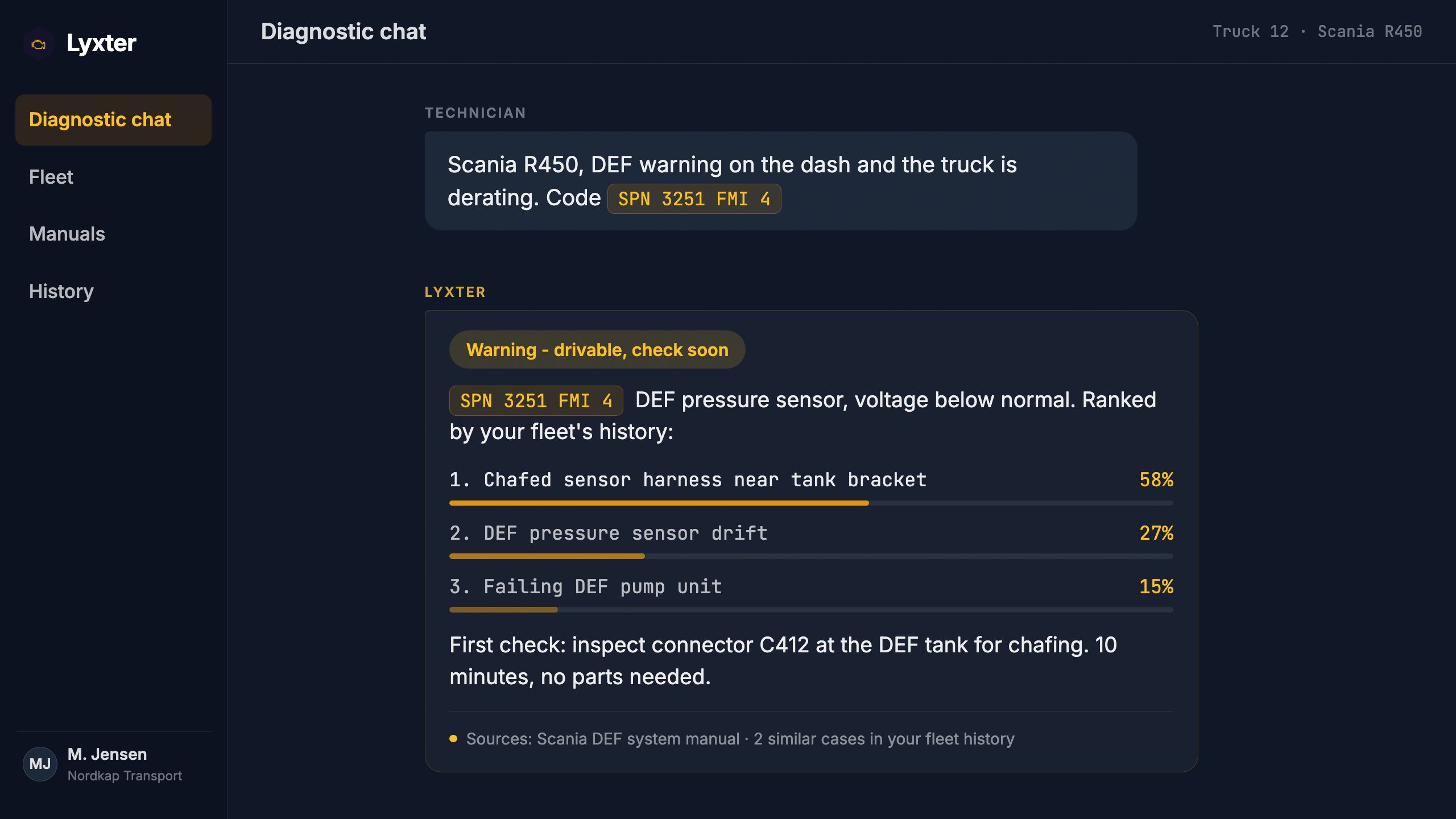
Real fault codes, real reasoning, grounded in your fleet's history.
Warning - drivable, check soon
P0420= Catalyst System Efficiency Below Threshold (Bank 1). With pre-cat swinging + post-cat flat low and normal EGT, three causes ranked by your fleet's history:
- 1. Aged catalyst element62%
- 2. Pre-cat lambda sensor drift24%
- 3. Exhaust leak upstream of cat14%
Suggested first check: swap the pre-cat lambda from a sister truck (5 min). Confirms or eliminates #2 cheaply.
The modules
Two modules. One record per machine.
Diagnosis is one part of the job. Fleet keeps every machine you service on file; Service runs and documents the work on it. What one records, the other already knows.
FleetPro plan
Know every machine you service.
Every machine gets its own page: make, model and year, its odometer or engine hours, its own manuals, its chats, and one timeline holding the faults, the repairs and the services with what they cost. Plan the maintenance by months, kilometres or engine hours, and Lyxter mails you when the work comes due.
An illustration of the Fleet list: four machines, each with its make, model and year, its latest odometer or engine-hours reading, and its service status - overdue, due soon, or waiting on a reading - above a short history for one of them.
- Schedules by months, kilometres or engine hours - the tightest one wins
- Email reminders the first time a service crosses into due or overdue
- A critical call in chat flags the machine and opens an issue on it
- Manuals for one machine, used by the AI on that machine only
- Link a chat to a machine and the AI answers with its history behind it
One loop
Finish a service on one of your own machines and the schedule moves on by itself: the reading updates, the reminders stop, and the job lands on that machine's timeline in Fleet.
ServicePro planBeta
Run the service. Hand over the proof.
Pick the service type and work the list: tick it, measure it, or leave a note. A measurement past its limit raises its own advisory, progress counts itself up, and anything still blank gets a nudge before you finish. Run it on one of your own machines, or on a customer's truck created right there on the job.
An illustration of a service job: a minor service on a truck, eighteen of twenty-four items recorded, with a brakes section showing a ticked item, a measured pad thickness carrying an advisory, a note, and an item marked not applicable, above a footer offering the report as preview, print or PDF.
- Tick, measure or note - one row for each thing checked
- Starter checklists, from a minor service to an annual inspection
- A report on your own letterhead, in English or Danish
- Only what was actually recorded reaches the report
- Every job searchable by vehicle, customer or job number
Lyxter does not mail the report or publish a link for it - the workshop hands it over itself, from preview, print or PDF. A report records what was checked and the condition observed at the time; it is not a statutory periodic inspection and does not replace one.
Explore ServiceBoth modules come with Pro, including up to 25 of your own machines. A customer's vehicle created inside a service job does not count against that.
Enterprise-grade by default.
EU data residency
Your data stays in the EU: hosted, processed, and stored inside European infrastructure.
Customer isolation
Your shop's repair history never trains a shared model. The knowledge the AI shares across workshops is general know-how it wrote itself, reviewed by our staff - never your data.
Audit trails
Every Lyxter answer is traceable to its source documents: bulletins, procedures, prior repairs.
Stop guessing. Start fixing.
Set your workshop up today, or book a demo with our team.